Your website is often the first impression your business makes on your customers. It can affect what they think, feel, and ultimately do: call or book with you.
However, websites aren’t built to last. A nice design might have been on-trend a few years ago, but technical problems can arise over time, hindering performance and SEO, while usability issues can hurt the customer journey.
If your online storefront doesn’t meet your current standards, it may be time to invest in a new WordPress website or redesign your current one.
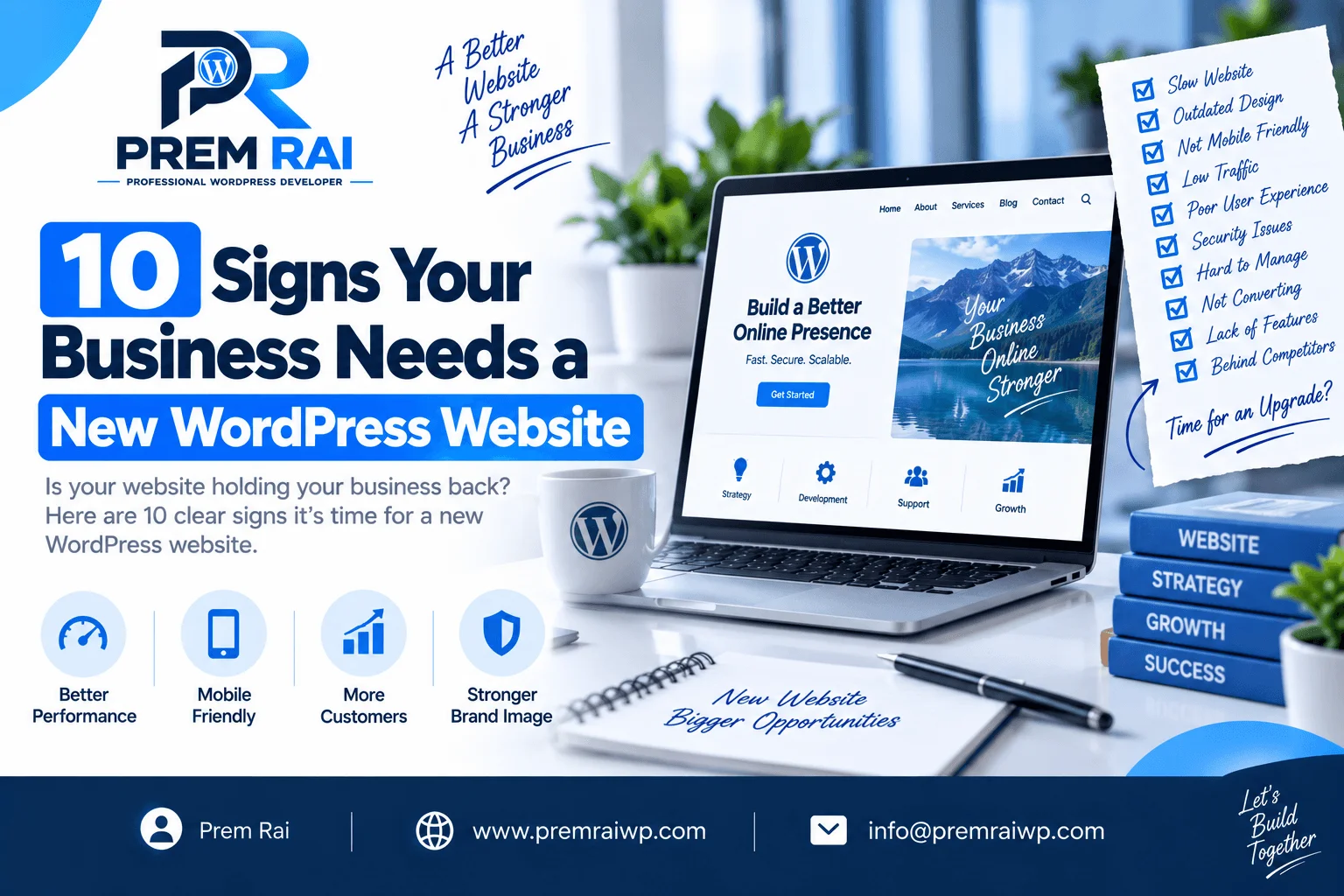
Here are 10 signs your business needs a new WordPress website.
1. Your Website Looks Outdated
One of the most obvious signs that a website needs to go is if it looks outdated.
Design aesthetics, user expectations, and technology evolve over time, and an old website design can suffer from:
- Outdated fonts
- Poor layout
- Smaller display sizes
- Cluttered design
- Old-style navigation
- Inconsistent branding
- Inadequate spacing
- Low quality or outdated graphics
While an outdated appearance doesn’t necessarily require a website rebuild, if your website design doesn’t reflect your business, it’s a good idea to consider a redesign.
Your website should reflect your company’s branding and the products and services you offer.
2. Your Website Isn’t Mobile Responsive
Modern business websites must be accessible and functional across all devices.
If your website looks terrible on smartphones, tablets, laptops, and desktops, or it’s challenging to navigate or use on mobile devices, it’s a problem.
Issues such as text that is too small to read or buttons that are too small to tap are examples of websites that need a redesign.
Mobile-friendly WordPress websites should use responsive design to ensure optimal display and usability across all devices.
3. Your Website Is Slow
Website speed is a critical consideration for both user experience and technical performance.
If it takes a few seconds for your web pages to load, you risk losing potential customers before they even reach your content.
Several underlying causes might be limiting your website’s speed, including:
- Poor hosting
- Large images
- Too many plugins
- Outdated themes
- Too many scripts
- Poor code optimization
- Database optimization
- Third-party tools
Before rebuilding a WordPress website, it’s important to explore options for optimizing the current WordPress site. However, if performance issues are due to underlying technical issues, a complete rebuild may be a more viable option in the long run.
4. Your Website Isn’t Easy To Update
Your business website shouldn’t require a developer’s intervention every time you want to update your content.
If it takes too long to add a service, update your contact information, publish a blog post, or make other minor changes to your website, it’s an indication that your site needs to go.
A new WordPress website can provide an improved content management system (CMS) experience.
Your website should enable your team or employees to update content and manage the website without a developer’s help.
5. Your Website Doesn’t Represent Your Business Anymore
Businesses constantly evolve.
You may have added new services, shifted your target market, expanded your operations, or updated your branding.
If your website reflects where your business was a few years ago instead of where it is now, it’s an indication that it’s time to rebuild it.
For example, your business may have grown from offering only 4 services to 10, but your website still advertises the former.
A new website allows you to restructure your website’s content to reflect the current state of your business.
6. Your Website Isn’t Generating Leads
Every business website should have a clear objective.
For example, many business websites’ primary goals are to generate leads, collect calls, get bookings or quotes, or increase sales.
If your website gets plenty of traffic but doesn’t seem to convert many visitors into customers, it could have several underlying issues.
Some common causes include:
- Poor call-to-action (CTA)
- Poor page organization
- Poor navigation
- Lack of trust signals
- Poor forms
- Poor service descriptions
- Slow website performance
- Poor mobile experience
A website redesign can address many of these issues by rethinking the user experience (UX) design and making important elements more accessible and prominent.
That being said, a website with poor conversion rates should be reassessed holistically before a rebuild, as the issue could stem from the traffic quality, pricing, promotions, or other areas unrelated to the website.
7. Your Website Has Security Issues
WordPress requires regular maintenance to keep it secure.
Many WordPress websites get hacked because they use WordPress versions, themes, and plugins that are no longer supported.
Warning signs of a potentially insecure WordPress website can include:
- Redirects
- Spam content
- Abusive users
- Malware detection
- Crashing or corrupted security plugins
- Hacked WordPress core files
- Multiple hacking attempts
- Outdated WordPress core, themes, or plugins
Sometimes, these issues can be resolved without rebuilding a website, but if your website platform is insecure, outdated, or unsupported, rebuilding it on a secure foundation is the best option.
8. Your Website Has Too Many Plugins
Plugins can extend the functionality of WordPress, but too many can create more problems than solutions.
Older websites tend to accumulate plugins with time, and a long list of plugins can be an indication that it’s time to rebuild your WordPress website.
Issues with plugins can include:
- Duplicates
- Inactive plugins
- Unnecessary plugins
- Plugin conflicts
- Performance issues
- Compatibility issues
A new WordPress website can help address these types of problems by reviewing the necessary WordPress tools and dependencies.
The goal shouldn’t be to exclude all plugins, but to only include tools that offer genuine value.
9. Your Website Isn’t SEO Friendly
Search engine optimization (SEO) is an essential practice for any online business.
SEO considers a variety of factors, including content quality and quantity, authority, backlinks, technical performance, and website structure.
If your website has significant technical problems holding it back from ranking well in search engine results pages (SERPs), it’s an indication that it’s time to rebuild your WordPress website.
Issues with SEO can include:
- Poor URL structure
- Duplicate pages
- Poor internal linking
- Poor heading structure
- Slow page speed
- Poor mobile friendliness
- Poor content management
- Technical errors
A new WordPress website can be built with technical SEO in mind, making it easier to rank in SERPs. However, it’s important to remember that redesigning a website can also interfere with existing SEO efforts. URL redirects, content optimization, and other factors should be taken into consideration when migrating to a new WordPress website.
10. Your Website Can’t Support Your Future Needs
One of the clearest indicators that a company needs a new website is if it can’t support the company’s future needs.
For example, your online storefront may need to support more advanced payments, an e-commerce platform, booking system, memberships, CRM, marketing automation, multiple locations, new service categories, or more.
If your website wasn’t built to scale and you’re constantly trying to add features or “workarounds” without a proper technical foundation, it’s time to rebuild it.
A new WordPress website can be built with extensibility and future-proofing in mind, evolving with your business over time.
New Website vs. Website Redesign
Not every outdated or underperforming website needs to be rebuilt from the ground up.
Sometimes, a WordPress website redesign is the most viable option.
This could be the case if the core WordPress installation, theme, content structure, and technical foundation are mostly healthy but could use an update.
A complete rebuild may be necessary if the website has outdated core technology, serious performance issues, poor code quality, or other underlying technical problems.
Ultimately, it’s important to perform a technical audit of the current WordPress website to determine the most viable option based on the specific circumstances.
What Should a New WordPress Website Include?
A professional business website typically focuses on responsive design, intuitive navigation, clear calls to action (CTAs), speed, technical SEO, content management, security, backups, analytics, and contact or lead generation features.
The exact requirements should be defined based on the specific needs of the business rather than a generic set of requirements.
Conclusion
A new WordPress website can be a wise investment if your existing WordPress website isn’t helping your business. Outdated designs, poor mobile friendliness, performance problems, poor content management, security issues, slow conversion rates, unnecessary plugins, SEO limitations, and an inability to evolve are all valid reasons to consider a new WordPress website.
However, a new WordPress website isn’t always the answer, even if the website looks old. A professional technical audit should be performed before making any major decisions.
The goal shouldn’t be to simply build a “newer” website, but rather to create one that represents your business, meets your customers’ expectations, fulfills your marketing and sales goals, and provides a solid foundation for growth.
Frequently Asked Questions
1. How do I know if my business needs a new WordPress website?
Outdated designs, poor mobile friendliness, performance problems, poor content management, security issues, SEO limitations, slow conversion rates, and an inability to fulfill future requirements are all indications that a website needs to go.
2. How often should a business redesign its WordPress website?
There is no hard and fast rule about when a business should redesign its WordPress website, but it’s important to assess the website’s performance, technology, security, user experience, branding, and requirements periodically.
3. Should I redesign my WordPress website or build a new one?
If the underlying WordPress core and theme are healthy, a redesign may be appropriate. If the WordPress installation, theme, or plugins are outdated or pose technical or security risks, a complete rebuild may be appropriate.
4. Can a new WordPress website improve website speed?
It can. If a website has performance issues due to an outdated theme, excessive plugins, poor coding practices, or other technical debt, a new WordPress website can help. However, website performance is influenced by many factors, including hosting, images, scripts, caching, and more.
5. Will a new website improve my SEO rankings?
A new website can improve many technical aspects of SEO, but it’s important to remember that SEO is a complex task that involves more than just building a new website. Content quality, relevance, competition, technical quality, and other factors should also be considered.
6. How much does a new WordPress website cost?
The cost of a new WordPress website varies depending on a variety of factors, including design, number of pages, functionality, custom coding, eCommerce requirements, content, and the expertise of the developer. A basic business website can be much cheaper than a complex custom WordPress solution.
7. Will I lose my Google rankings when rebuilding my website?
A website rebuild can affect a website’s Google rankings in several ways, depending on how it’s done. It’s important to carefully plan a website rebuild to minimize risks, including maintaining important URLs, implementing redirects, and preserving valuable content.
8. How long does it take to build a new WordPress website?
It depends on the size and complexity of the website. Larger or more complex WordPress sites or those with custom coding, eCommerce, or other requirements can take much longer to build.
9. Can I keep my existing domain when building a new WordPress website?
Yes. Most WordPress websites can keep the same domain name while building or rebuilding the website.
10. What should I prepare before rebuilding my WordPress website?
Before rebuilding your website, it’s a good idea to have a clear vision of what you want to achieve with the new website. This includes defining your target audience, desired pages, features, branding, content, SEO requirements, and budget. It’s vital to identify important URLs, analytics data, and other website elements that should be migrated to the new website.
